
Find Golden Valley Residents Carefully
Golden Valley does not have one official resident roll. Hennepin County’s property search is useful when an address is known, but its owner or taxpayer display is an administrative property field. Minnesota’s individual voter tool is for checking one known registration record, not for building a neighborhood list. A recorded instrument names parties to a real-estate transaction, while a directory page captures a date in the past. Each source has a different purpose and date.
Begin with the narrowest fact already in hand. A complete address can lead to a parcel ID, a legal description, a permit file, and a deed index. A full name plus a date or address may be tested in court, vital-index, or voter routes where public access permits it. For an older household, directory pages, yearbooks, maps, and newspapers are usually a better first stop than a current parcel card. The Golden Valley residents directory is strongest when its sources are used as separate checks.
- Validate the complete address and identify the municipality rather than relying only on a mailing-city line.
- Use Hennepin Property Information Search to obtain the PID and legal description for a parcel question.
- Use the Recorder, court, or city custodian that holds the next record, preserving its date and identifier.
- Compare a historical directory or archive hit with a dated primary record before treating it as verified.
- Ask the City Clerk or responsible department for existing releasable records when a public index stops.
Golden Valley Resident Record Custodians
The City of Golden Valley holds municipal files such as permits, planning material, council records, public-works documents, and releasable police data. Hennepin County keeps the assessor, tax, Recorder, elections, and district-court systems that often supply the next link. State agencies administer statewide tools and vital-record rules. Sending a request to the office that actually keeps the record saves time, especially where a city address is served by a county database.
The City Clerk is the practical starting point for a city request that does not have a public search. The county tax system supplies parcel context, but the Recorder holds land instruments and the court holds court records. Library collections are historical sources, not replacements for a current agency file. Golden Valley requests work best when they state the address, date range, department, file type, and a request to inspect or receive copies.
Golden Valley City Clerk
7800 Golden Valley Road
Golden Valley, MN 55427
763-593-8012
Hennepin Property Information
300 South Sixth Street
Minneapolis, MN 55487
612-348-3011
For a street-by-street address task, the county property application and its follow-up records are described in the Golden Valley by-street directory. Municipal material that is not exposed in a search form remains a records-request question, not a reason to assume the file does not exist.
Golden Valley Requests Under Chapter 13
Minnesota’s Government Data Practices Act starts with public access but recognizes private, confidential, and otherwise nonpublic data. Golden Valley accepts a public-data request through its online portal, by email, mail, or fax. The portal offers Public Data, Data on an Individual, and Police Data categories, and permits an ordinary public-data request without an account. A requester generally need not give an identification document or a reason for ordinary public data, although contact information helps when the city must send copies.
Make the request fit a record system. Name the address or PID, department, file type, and date range, then say whether inspection, copies, or both are sought. A permit request can ask for applications, inspection results, certificates of occupancy, and plan-review correspondence. For protected material, ask the custodian to release public portions after redaction and identify the classification used for the rest. The city may charge allowable copy costs, but inspection and redaction itself are not billed as a general rule.
Golden Valley Parcel Keys and Records
Hennepin’s property application is the useful starting point for a parcel, not a universal name search. Its address mode requires a house number and street name, allows an optional unit number, and offers address, PID, addition-name, and tips tabs. The county updates the database on business nights at about 9:15 p.m. A result can display a taxpayer or owner field, mailing and situs addresses, PID, legal description, tax and assessment information, sales, a map link, and recent recording history.
Search tips are important in Golden Valley because the street box is not a free-form ZIP or city search. Use the exact house number, test documented street abbreviations, and place a direction at the end. If a unit is involved, repeat the query with the unit number. Preserve the spelling returned by the application. The PID and legal description are the stable keys that carry the result into GIS, Recorder, city permit, and historical research.
| Property search field | Use | Format or limit |
|---|---|---|
| House number and street | Find a parcel by situs address | Both required; unit is optional |
| Property ID | Reconnect a known parcel | Supply all 13 digits; spaces or dashes work |
| Addition, lot, and block | Test a historic subdivision lead | Addition required; lot and block optional |
| Legal description | Carry the parcel into Recorder research | More stable than a mailing label |
A PID is the county’s property identifier. A legal description identifies land through a plat, lot and block, or another recorded description. A situs address is the physical property address, while a mailing address can belong to an owner, taxpayer, or agent. Recent recording history is only a five-year convenience display, so an older ownership question belongs in the Recorder’s system or at its research kiosks.
See the Hennepin address-search application before choosing a spelling.
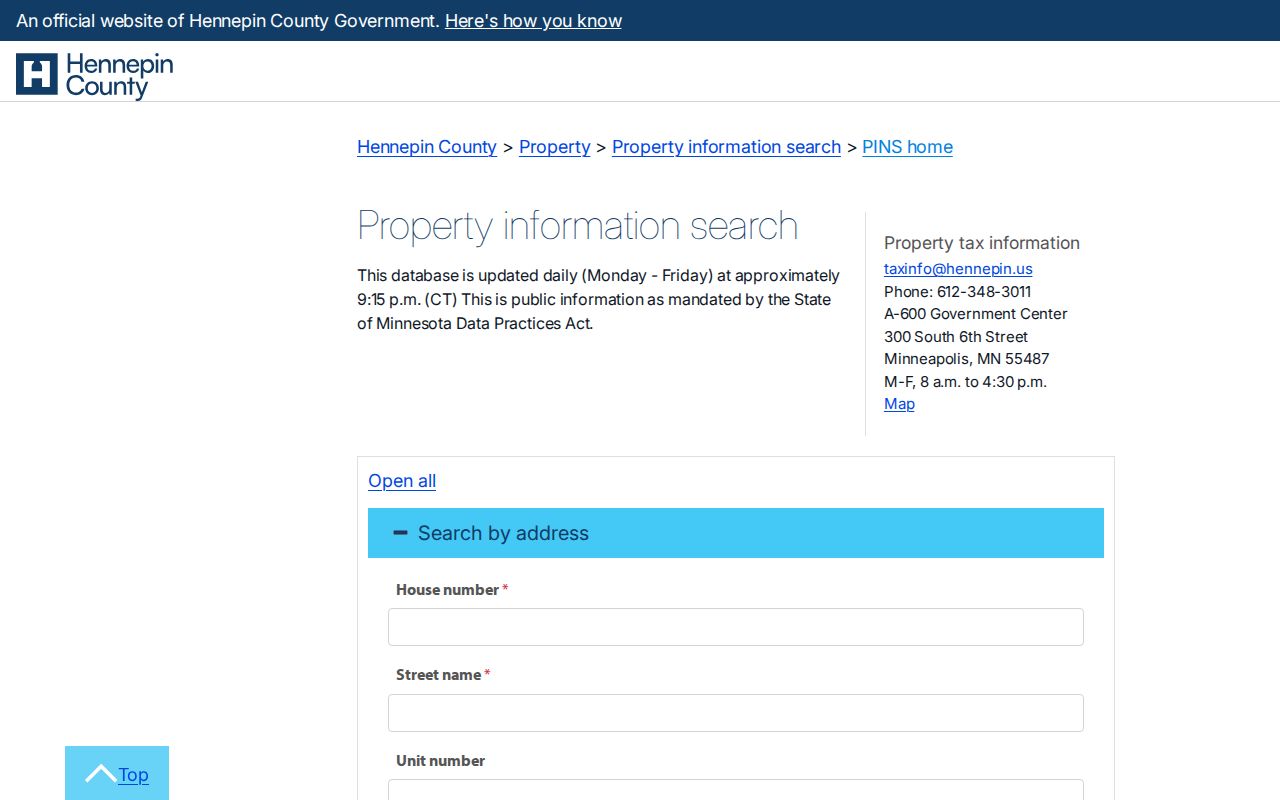
The visible house-number, street, and unit fields show why a full address is more useful than a ZIP-only search when resolving a Golden Valley parcel.
Current Golden Valley Resident Sources
Current sources provide narrow kinds of evidence. A parcel card answers a tax and property question. A voter registration match addresses one individual registration when the required facts are already known. MCRO can show public case activity, and public city records can document an address-keyed project. None should be treated as a complete list of people who live in Golden Valley, and a mailing address does not prove present residence.
| Record route | What it can confirm | Custodian | Access path |
|---|---|---|---|
| Property Information Search | Parcel identity, displayed taxpayer or owner, mailing and situs fields | Hennepin County | Free address, PID, or addition search |
| MNVotes | Individual registration match and voting links | Minnesota Secretary of State | Name, birth date, and exact address required |
| MCRO | Public cases, events, hearings, judgments, and eligible documents | Minnesota Judicial Branch | Search filters; older and restricted material may need another route |
| City permit or planning file | Address-keyed project and municipal review trail | Golden Valley department | ePermits from 1995 or a Chapter 13 request |
| Recorded land instrument | Parties, recorded date, and instrument type | Hennepin Recorder | RecordEASE, kiosks, copy routes, or staff help |
When the goal is to confirm one person across carefully matched records, the Golden Valley resident lookup separates name-search results from verified records. Record the date shown by each source because a valid older result can still be a historical snapshot.
Golden Valley Mail Can Say Minneapolis
Golden Valley has four confirmed ZIP codes: 55416, 55422, 55426, and 55427. They cross municipal lines. The official Golden Valley postal station at 7701 Golden Valley Road uses a Minneapolis, MN 55427-9998 mailing line, so a Minneapolis label alone does not settle the municipality. A ZIP is a mail-delivery convention, not a legal boundary or a substitute for a parcel record.
Test the full address with the USPS ZIP Code Lookup, then confirm the municipality, PID, and legal description through county property sources. The city’s road history also matters. Watertown Road is the present Golden Valley Road, and roads crossing a border can keep one shared name. Older directories, maps, and permits may therefore need the modern name, the historic name, and directional variants.
Golden Valley Voter Records Have Limits
MNVotes requires first name, last name, full date of birth, and an address route through ZIP or county. The street is selected from the system, and a unit field becomes required when indicated. It is designed for an individual registration check. The system updates nightly, while election officials can take up to 14 days to process a registration before it appears the next day.
State law makes certain registration fields public but restricts list use to elections, political activities, or a law-enforcement inquiry. A lawful bulk request uses the Secretary of State’s certified request form, a defined geography, a permitted format, payment, and a requester certification. It does not turn the voter system into a general Golden Valley residents directory. Full date of birth, government identification numbers, email, and several registration fields are not public list data.
MNVotes shows the individual entry point and its required inputs.
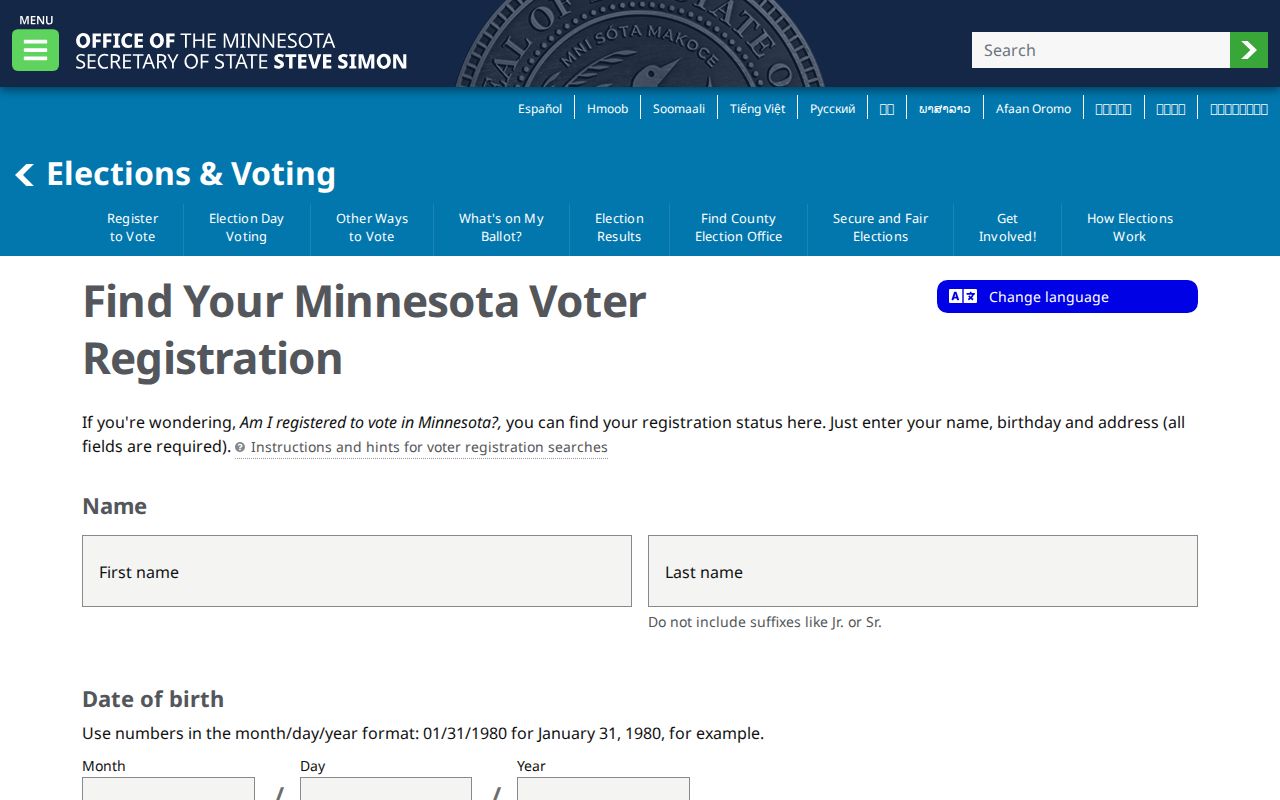
The form’s combination of identity and exact-address fields is an important access boundary, not a shortcut for a block-wide search.
Golden Valley Recorder Research Paths
Hennepin’s Recorder and Registrar of Titles records deeds, mortgages, assignments, releases, liens, plats, and Torrens material. Start with the PID and legal description from the assessor, then search the legal description and the indexed individual or entity name. About 45 percent of county property is Torrens, so a complete property investigation may require a certificate of title and memorial history rather than a deed alone.
RecordEASE Public Search is limited, while RecordEASE Pro is described as having no monthly or search fee and generally charges $2.50 for a retrieved document, certificate, or plat. Public research kiosks are in room SK-0353 on the Skyway level of the Hennepin Government Center, generally weekdays from 8:00 a.m. to 4:30 p.m. Noncertified copies, certified copies, mail requests, and Virtual Recorder routes provide alternatives when a public index does not give the needed image.
The Recorder research page explains the copies, kiosks, and Property Watch options.
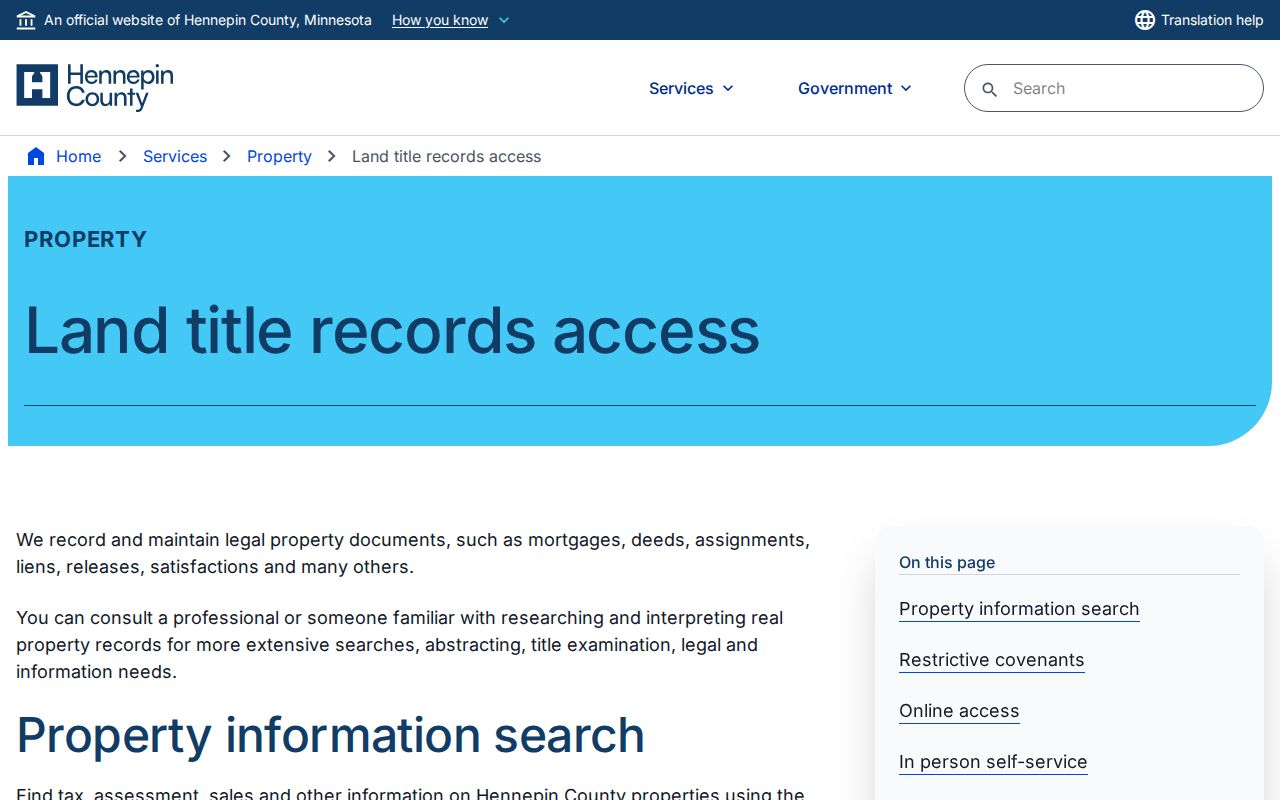
Recorder research follows legal descriptions and indexed instruments, which is why it complements rather than replaces the assessor’s address search.
Golden Valley’s 1951 to 1981 Directories
Hennepin County Library’s digitized Golden Valley city-directory collection is a major local historical route. The ResCarta collection displays a Golden Valley subset labeled 1951 to 1981, with 22 entries visible in the inspected collection. Its controls include subject or city, publisher, place, year, and title or publication-date sorting. Search both an address and a surname, then retain the volume title, year, page image, and any page number.
A directory may give a resident name, occupation, spouse, business, or street address. It is a dated publication, not proof of ownership or continuous occupancy. HCLIB’s broader directory collection reaches 1859 to 1983, and Special Collections also holds yearbooks, clippings, maps, photographs, web archives, and other local-history material. The Golden Valley city directories page details the collection and citation trail.
Earlier Golden Valley Resident Trails
Before the city’s 1886 incorporation, an address or land reference may sit under a township or county description. The 1893 annexation can also affect a historical jurisdiction label. Golden Valley’s growth after the Electric Luce Line crossed the area in 1912, later highway construction, 1930s zoning, and the 1959 land-use plan created records in different departments and eras. Use this context to choose a search variant, not to infer a fact about a particular property.
For an old address, pair the directory timeline with the county Recorder, tax records, historic maps, plats, and city requests. Hennepin tax records from 1860 to 1901 have State Archives and FamilySearch catalog routes. MNHS People Records has index coverage for Minnesota births from 1900 to 1934 and deaths from 1904 to 2001. Hennepin civil case files from 1858 to about 1934 can be held off site by MNHS. These are leads with their own access rules, not a single historical person file.
Golden Valley Results Need Matching
A matching name is only a lead. Compare the source date, address, PID, legal description, case number, certificate or index number, and record type before connecting two results. A current assessment card can contain an administrative mailing address. A directory may establish an occupant on its publication date. A court result can identify a party but may be restricted, old, or associated with another person of the same name.
- Roll
- A list maintained for a specific purpose, such as property administration or voter registration.
- Index
- A searchable guide to records, which may not include the underlying image or certified copy.
- Criss-cross directory
- An address-oriented directory arrangement used to locate a historical household or business by street.
- Parcel
- A defined tract of land tracked by the county through a PID and legal description.
Keep a result ledger with the query, filters, source URL, access date, result count, and identifiers. A negative search should document the spelling and coverage limitation rather than being treated as proof that no record exists.
Golden Valley Records Are Not Unlimited
Public access has boundaries. Birth records have eligibility and confidentiality rules. Court access varies by case type and filing date. Safe at Home protects designated addresses for people facing safety threats, and driver or vehicle records are not general resident-search tools. Minnesota voter data also has narrow permitted uses. A custodian can release a redacted record, cite a classification, or explain that it does not maintain the requested data.
Official records are traceable to a custodian and include access rules, while commercial compiled-data products can combine stale or mismatched material and may not reveal their source. Use the primary record to check a claim. Do not reproduce protected addresses, full dates of birth, signatures, financial identifiers, or information about victims or minors merely because a source displays it.
Golden Valley Portal Gaps and Fallbacks
Some useful coverage has a clear start date. Golden Valley ePermits is searchable from 1995 forward, and the HCLIB Golden Valley directory run is 1951 to 1981. Other limits are less precise. Hennepin’s public property page shows only the last five years of recent recording history and does not publish the earliest year in its online deed index. The live GIS layer list and exact assessor result card also need browser confirmation.
When an online search ends, use the documented fallback. The Recorder offers kiosks, staff routes, copies, and certificates. The city accepts a focused Chapter 13 request. HCLIB and MNHS have research collections and staff services. Court terminals or the Records Center may reach older public material. A clear gap note is better than pretending a portal’s present screen covers every Golden Valley record ever created.